Money is one of the most useful things a child learns in math: it uses addition, place value and, later, subtraction with a real goal. This article follows the steps of the free money worksheet generator, from a few coins to making change.
Counting money, step by step
| Age | Exercise | In US dollars |
|---|---|---|
| 6-7 | A few small coins to add | Pennies, nickels and dimes |
| 7-8 | More coins to add | Quarters are added |
| 8-9 | Coins and small bills, up to 7 pieces in a box | Nickels, dimes, quarters, 1 and 5 dollar bills |
| 9-10 | Making change | 5 or 10 dollar bills, prices in steps of 50 cents |
| 10-11 | Making change | Bigger bills, prices in steps of 5 cents |
Counting coins
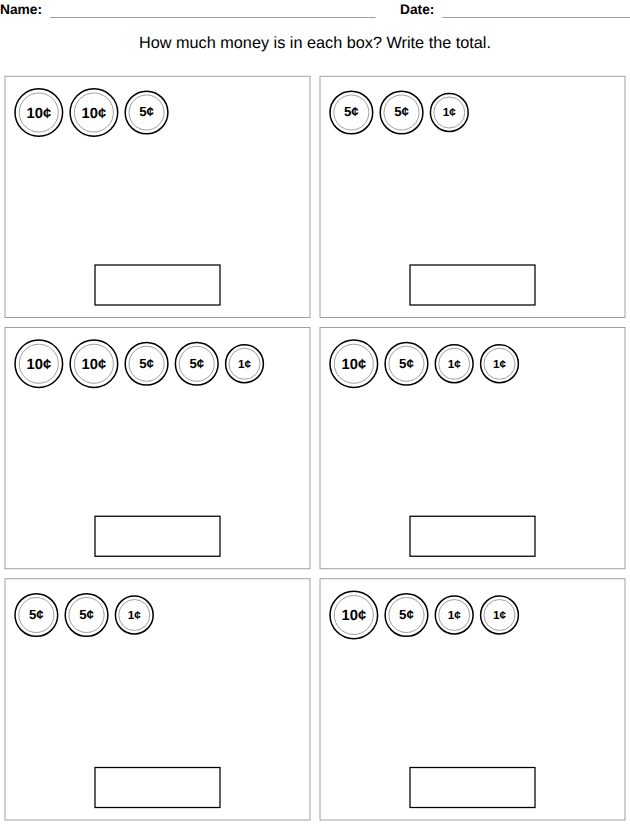
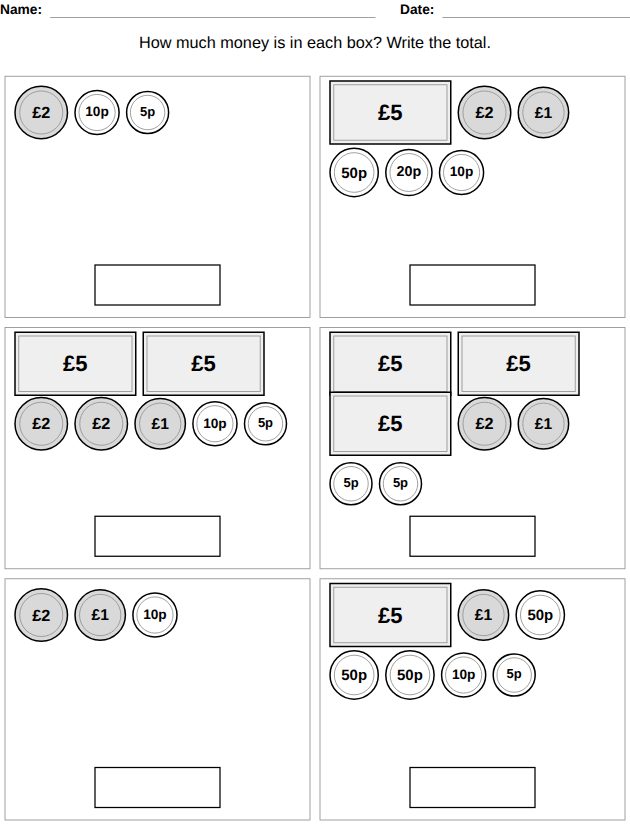
Each page has six boxes of coins. The child adds the coins in each box and writes the total. At ages 6-7 there are only a few small coins, so the totals stay small.
Tip
Count the biggest coins first, then add the small ones. Put real coins on the table for the first pages.
Coins and bills
At ages 8-9 the boxes mix coins and small bills, up to 7 pieces in a box. In pounds, for example, that means coins from 5p to £2 and £5 notes.
Making change
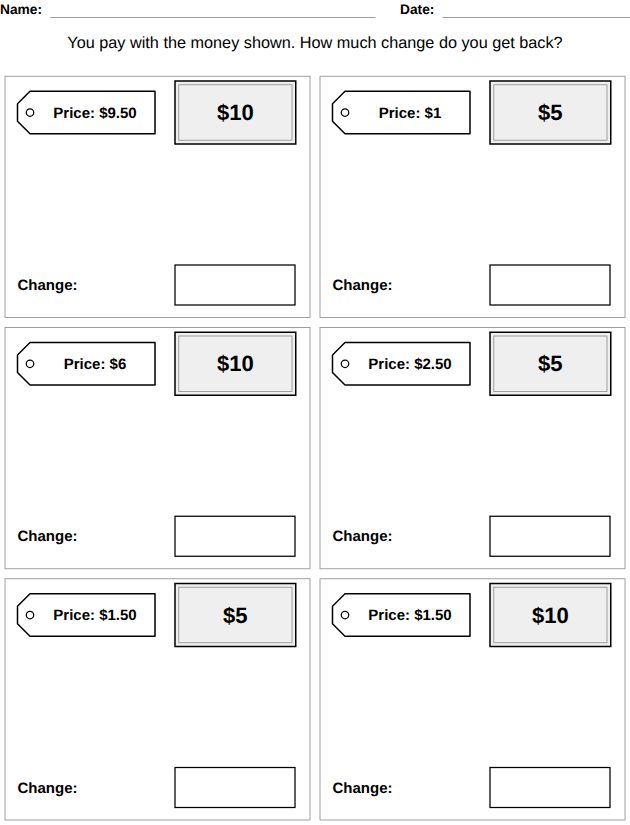
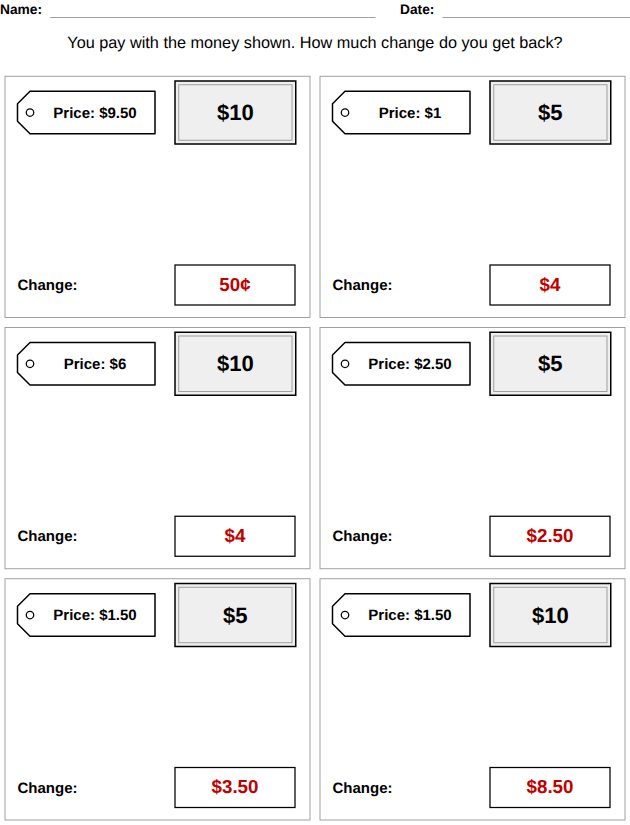
From ages 9-10, the page shows a price tag and the money paid: the child works out the change. Prices move in steps of 50 cents at ages 9-10, then in steps of the smallest everyday coin at ages 10-11 (5 cents for most currencies).
Count up from the price
Many children find change easier by counting up from the price to the money paid than by subtracting.
Eight currencies
The coins and bills are the ones of the chosen currency: US, Canadian, Australian or New Zealand dollars, British pounds, euros, Swiss francs or Mexican pesos. The currency of the language is offered first, and every other currency stays in the Currency menu. Money is also part of a workbook with fractions and measures: see how to make a fractions, measurement and money workbook.
Questions
Which currencies can I choose?
US dollar, Canadian dollar, Australian dollar, New Zealand dollar, British pound, euro, Swiss franc and Mexican peso, in any of the 5 languages. For example, a worksheet in English can count pounds or euros.
Why are small amounts written in cents?
Small amounts stay in cents, such as 25¢ or 50p, because a child reads 25¢ more easily than a decimal amount.
Which ages and grades can use the worksheets?
Ages 6-7 to 10-11, which is Grade 1 to Grade 5.
Is there an answer key?
Yes, with the total of each box or the change. The PDF has the worksheet and its answers.
Related articles
- All-in-One Kids Workbook by Age: Every Subject in One Book
Eight subjects in one book, an example for ages 6-7, and how to stay under the page limit.
- How to Make a Picture Activity Workbook for Preschool
Picture activities for ages 3 and up, with pages to cut out and a picture dictionary in one or two languages.
- How to Make a Logic Workbook for Kids
Five logic games in one book, including screen-free coding with a robot on a grid.
- How to Make a Fractions, Measurement and Money Workbook
Four topics of everyday math in one book for ages 5 to 11.
- How to Make a Coloring and Drawing Workbook for Kids
Six coloring and drawing activities, from tracing a drawing at age 3 to symmetry on a 12x12 grid.
- How to Make a Word Games Workbook for Kids
Five word games in one book, with grid sizes and word lengths by age.
Sources
This article is based on LogikLand's own puzzle generators.
Want to make a whole kids workbook?
LogikLand makes complete educational workbooks for ages 3 to 11: math, telling time, handwriting, word games, colouring, money, logic and picture activities, with the answer key at the end. Commercial rights come with the PRO and EXPERT plans.
Related: All blog articles | Try the tool | All free puzzle generators | More Kids worksheets articles