Math at home works best in small steps: a page that is a little hard, but not too hard. This guide lists what children usually practise from age 4 to age 11, based on how the LogikLand math worksheets are built, and shows real pages for each step. Every worksheet shown here was made with the free math worksheet generator.
What to practise at each age
The table sums up the levels of the generator. The ages are a guide: if a page feels too easy, choose the next age; if it is too hard, go back one level.
| Age | Addition and subtraction | Multiplication and division |
|---|---|---|
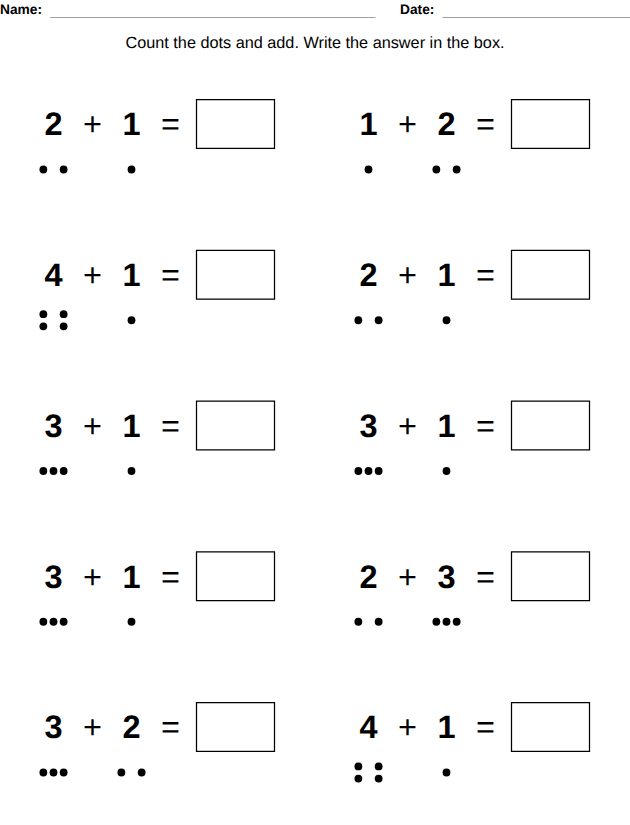
| 4-5 | Dots to count under each number, sums up to 5 | - |
| 5-6 | Sums up to 10 | - |
| 6-7 | Up to 20, with a few missing numbers | - |
| 7-8 | Column addition with carried digits | 2, 3, 4, 5 and 10 times tables |
| 8-9 | 3-digit numbers in columns | All tables from 2 to 10, division facts |
| 9-10 | 4-digit numbers | Column multiplication by one digit, long division with a remainder |
| 10-11 | 4-digit additions, 5-digit subtractions, three numbers to add | Multiplication by a 2-digit number, division by a 2-digit number |
Addition and subtraction
The first pages do not ask the child to know the sum by heart. At ages 4-5, each number has dots under it, so the child counts the dots and writes the total. From 5-6 the dots go away and the sums grow to 10, then to 20 at ages 6-7, where a few equations have a missing number instead of a missing answer (for example 8 + □ = 12).
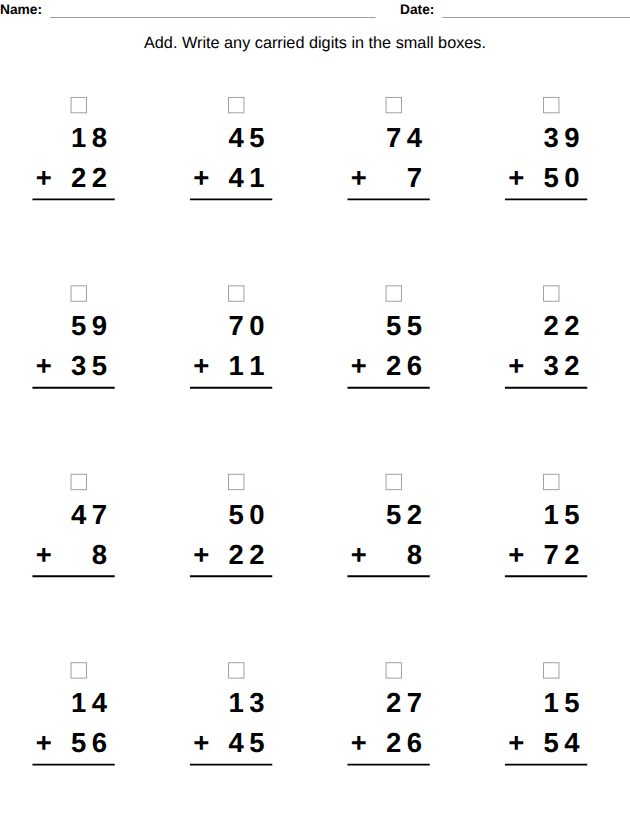
From ages 7-8 the calculations are written in columns. Above each column there is a small box for the carried digit, which helps the child remember it. Subtraction follows the same path, and the child regroups when the top digit is smaller. At ages 10-11, additions go up to 4 digits (sometimes three numbers at once) and subtractions up to 5 digits.
Tip
Ask the child to say the carried digit out loud and write it in the box before adding the next column.
Times tables and division
Multiplication starts at ages 7-8 with the 2, 3, 4, 5 and 10 times tables, which are the easiest to see as jumps on a number line. At ages 8-9 all the tables from 2 to 10 are mixed. Then the page changes: column multiplication by one digit at ages 9-10, and by a 2-digit number at ages 10-11.
Division comes one year later: division facts at ages 8-9 (the tables read backwards), long division by one digit with a remainder at ages 9-10, then 4-digit numbers and division by a 2-digit number at ages 10-11.
Mental math and number pyramids
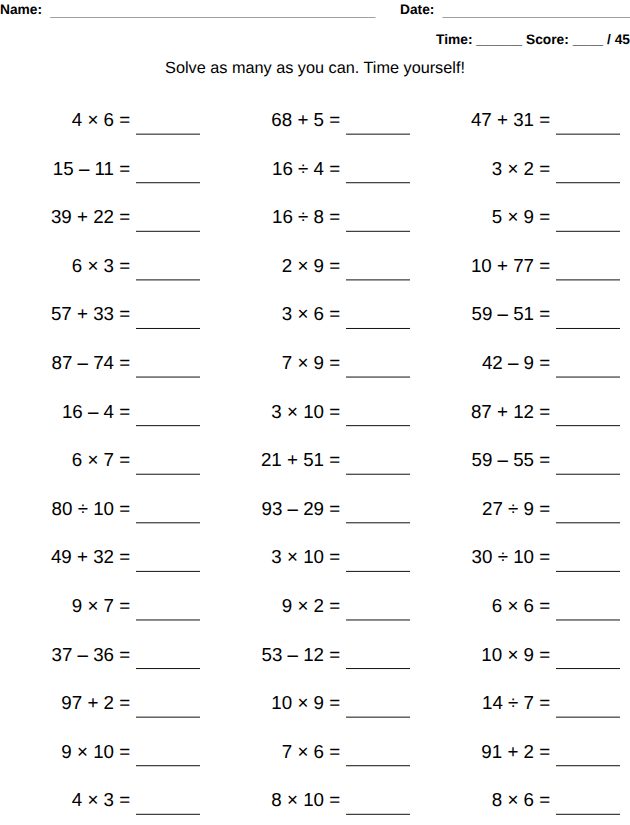
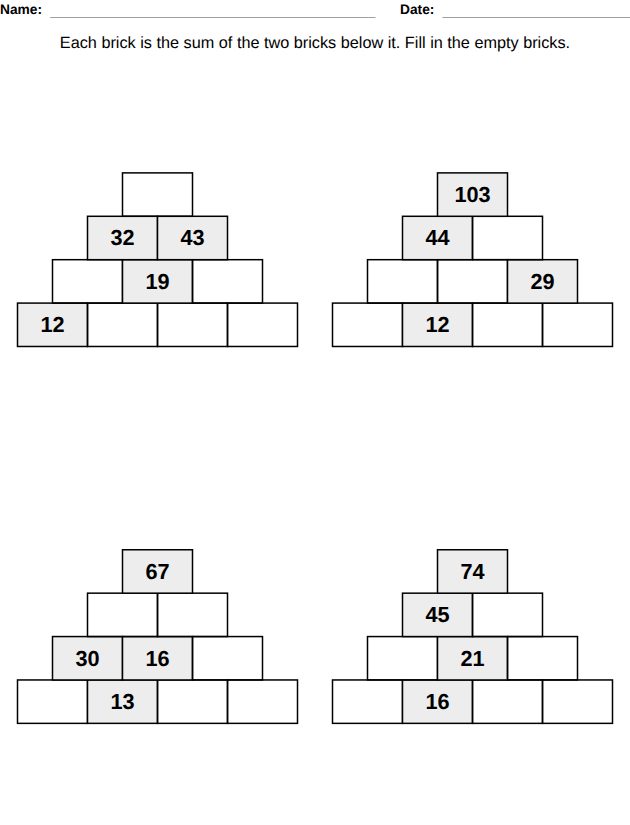
Two pages help with speed and with thinking about numbers. The mental math page has 45 quick calculations and a Time and Score line: the child can try to beat their own time the next day. The number pyramid asks for a different kind of thinking: each brick is the sum of the two bricks below it, and from ages 8-9 some bottom bricks are hidden, so the child has to subtract to find them.
How to use the worksheets
Short and often
One page a day is often easier for a child than several pages once a week. A fresh page every day is easy to get: each click on New worksheet draws new numbers with the same settings.
Check with the answer key
Every worksheet has an answer key on a second page. Print it on its own sheet and keep it for the adult, or let older children check their own work.
Mix the pages
Alternate a page of calculations with a page that feels like a game, such as a math maze or a color by number with sums.
Questions
At what age do children start column addition?
In the LogikLand worksheets, additions are written in columns from ages 7-8, with small boxes for the carried digits. Before that, children add with dots (ages 4-5) and then in a row, up to 10 and then 20.
Which times tables come first?
The worksheets for ages 7-8 use the 2, 3, 4, 5 and 10 times tables. All the tables from 2 to 10 come at ages 8-9.
Are the worksheets different every time?
Yes. The free generator draws new numbers each time you click New worksheet, and every worksheet comes with its answer key.
Can I print the worksheets in another language?
Yes, in English, French, Spanish, German or Italian. The instructions follow the language, and so does the way long division is written, for example with the French-style frame in French.
Sources
This article is based on LogikLand's own puzzle generators.
Want to make a whole kids workbook?
LogikLand makes complete educational workbooks for ages 3 to 11: math, telling time, handwriting, word games, colouring, money, logic and picture activities, with the answer key at the end. Commercial rights come with the PRO and EXPERT plans.
Related: All blog articles | Try the tool | More Kids worksheets articles