Kids workbooks / Telling time

Telling Time Workbook Generator: Clock and Calendar Worksheets for Ages 5 to 11

The LogikLand telling time workbook puts 6 kinds of clock and calendar worksheets in one book. Children start with o’clock times at age 5 and end with minutes, seconds and elapsed time at age 11. Choose the levels by age or by school grade: the times on the clocks follow the level, and the answer key is added at the end.

  • 6 kinds of worksheets
  • Ages 5 to 11
  • O’clock to every minute
  • 5 languages
  • Answer key included

6 clock and calendar worksheets in one workbook

Every clock shows a new time on every page. The pictures below are real pages made by the generator, in English; the French examples further down show the 24-hour clock.

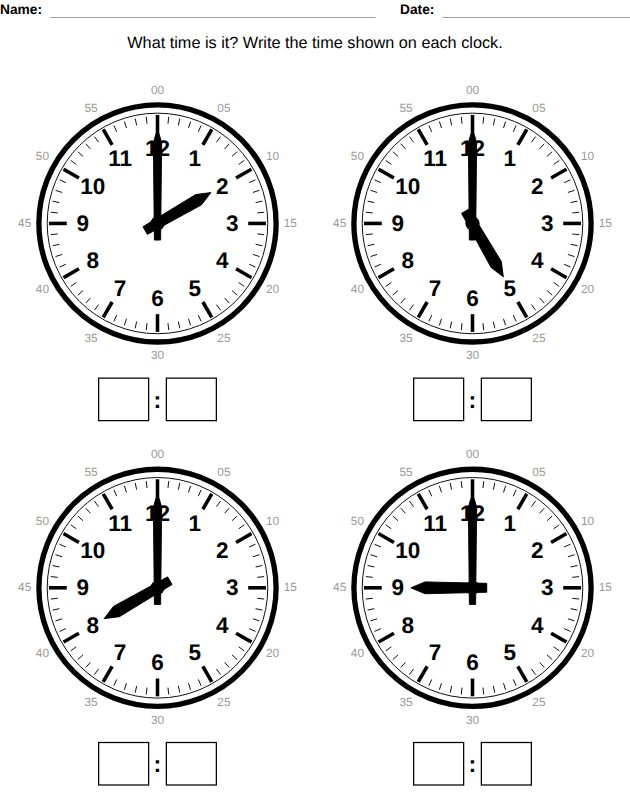
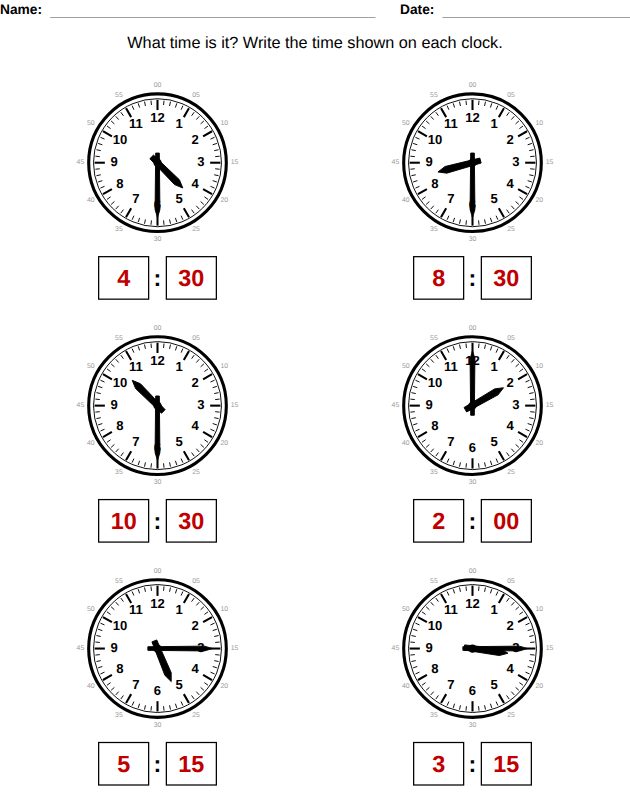
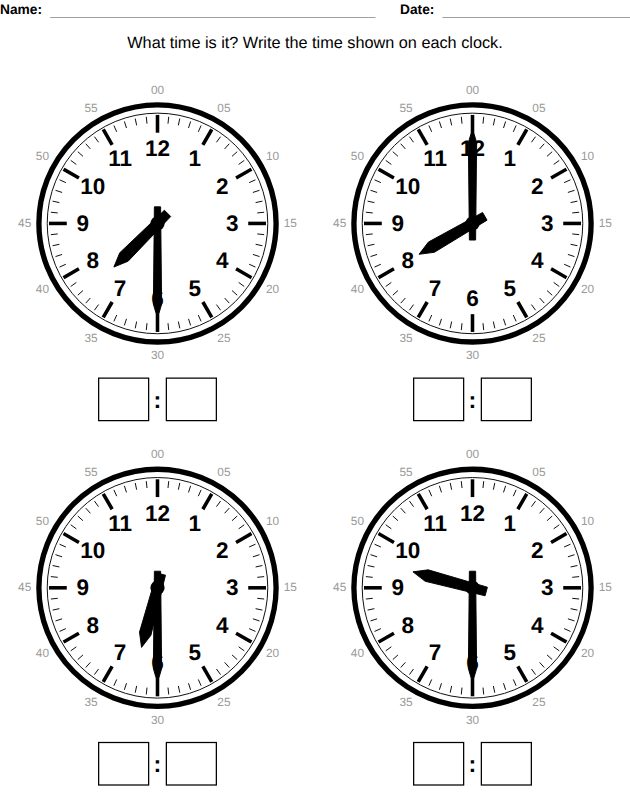
Read the clock worksheet for kids, from the LogikLand telling time workbook

1. Read the clock

Ages 5 to 11

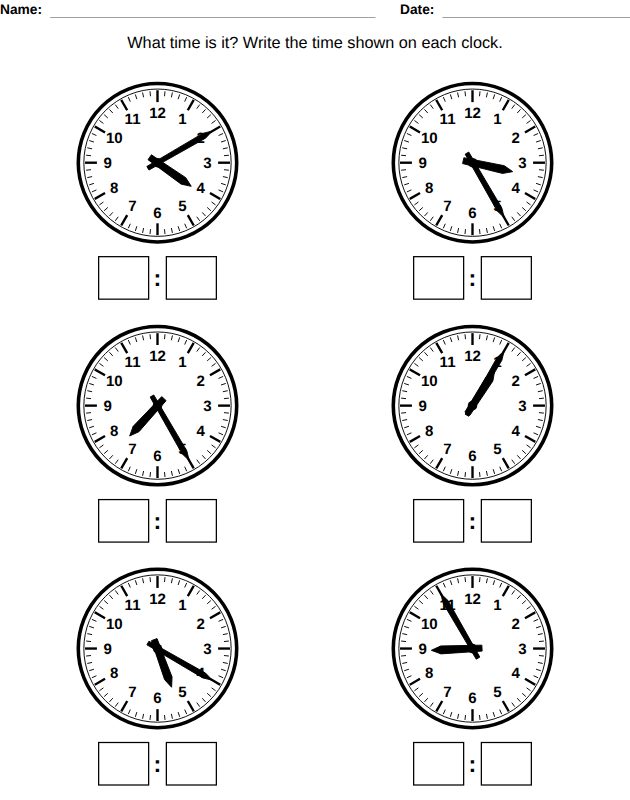
Children write the time shown on each clock in the boxes under it. The minutes follow the level: o’clock only at ages 5-6, o’clock and half past at 6-7, quarter hours at 7-8, 5-minute steps at 8-9, then any minute from ages 9-10.

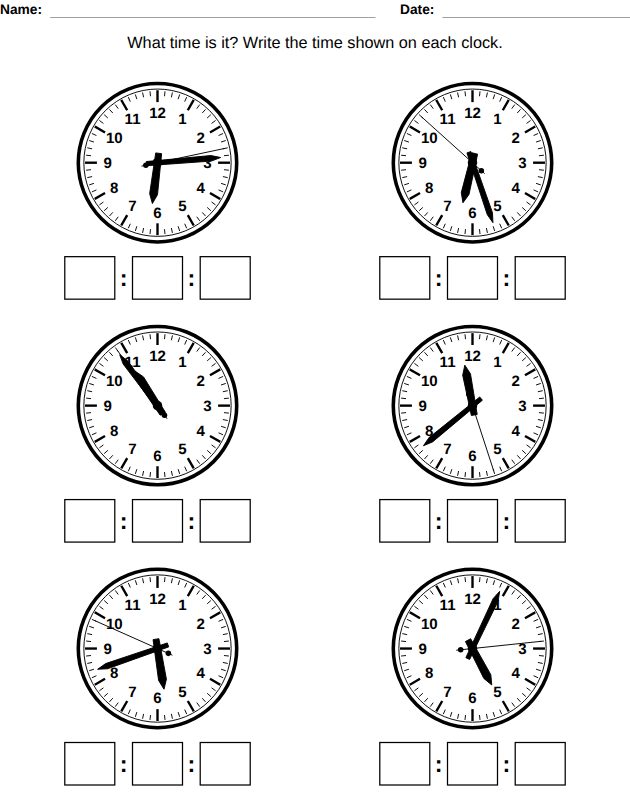
Up to ages 7-8 the minutes are printed around the clock face to help. At ages 10-11 a seconds hand is added and the child writes hours, minutes and seconds.
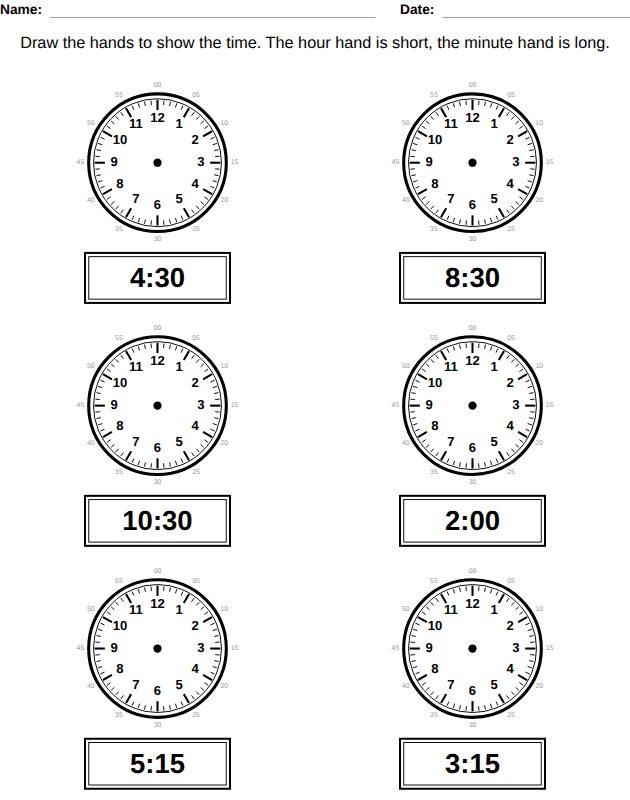
Draw the hands worksheet for kids, from the LogikLand telling time workbook

2. Draw the hands

Ages 5 to 11

The time is written under an empty clock face and the child draws the two hands. The instruction reminds them that the hour hand is short and the minute hand is long. The times follow the same steps as the reading worksheet.

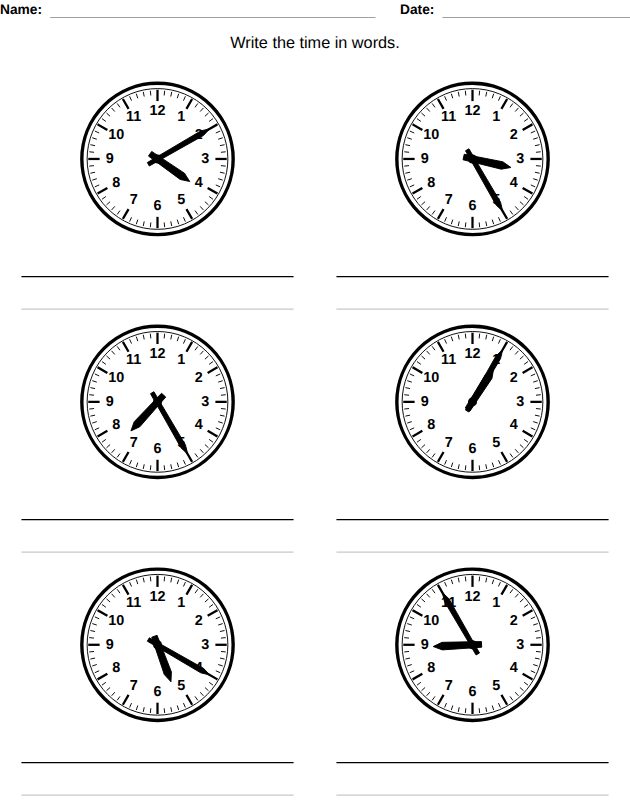
Time in words worksheet for kids, from the LogikLand telling time workbook

3. Time in words

Ages 7 to 11

Children write the time of each clock in words on the line, for example “quarter past three” or “ten to six”. Quarter hours at ages 7-8, then 5-minute steps. In the other languages the words follow that language, for example “trois heures et quart” in French.

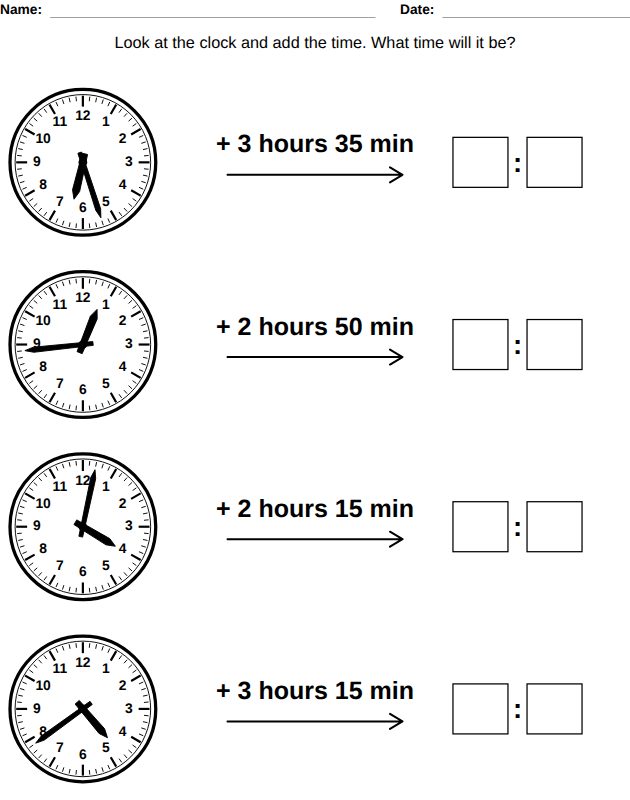
How much time? worksheet for kids, from the LogikLand telling time workbook

4. How much time?

Ages 8 to 11

Four clocks per page, each with a time to add, such as “+ 2 hours 15 min”. The child writes the time it will be. At ages 8-9 the added time is whole hours and half hours, at ages 9-10 it moves in 5-minute steps, and at ages 10-11 it can be any number of minutes.

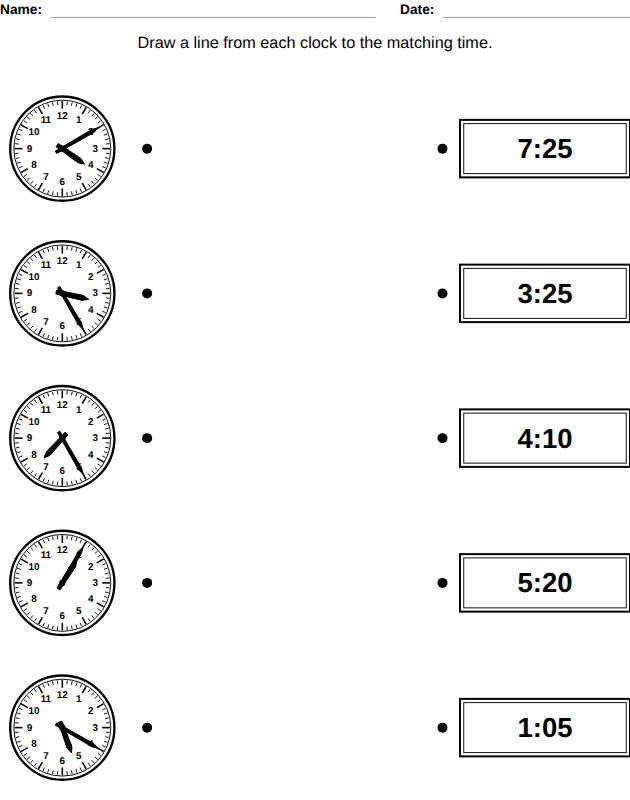
Match the clocks worksheet for kids, from the LogikLand telling time workbook

5. Match the clocks

Ages 7 to 11

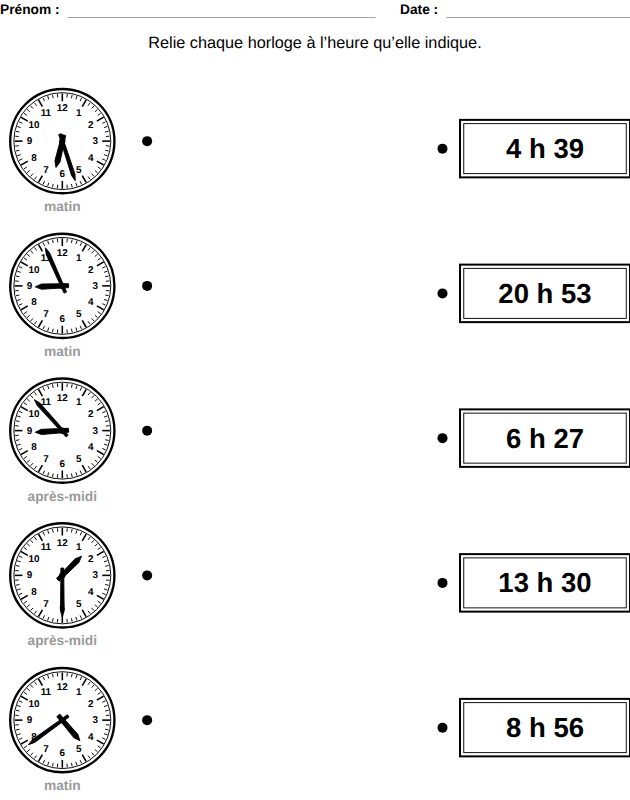
Five clocks on the left, five digital times on the right in a different order: the child draws a line from each clock to its time. Quarter hours at ages 7-8, 5-minute steps at 8-9, any minute from 9-10.

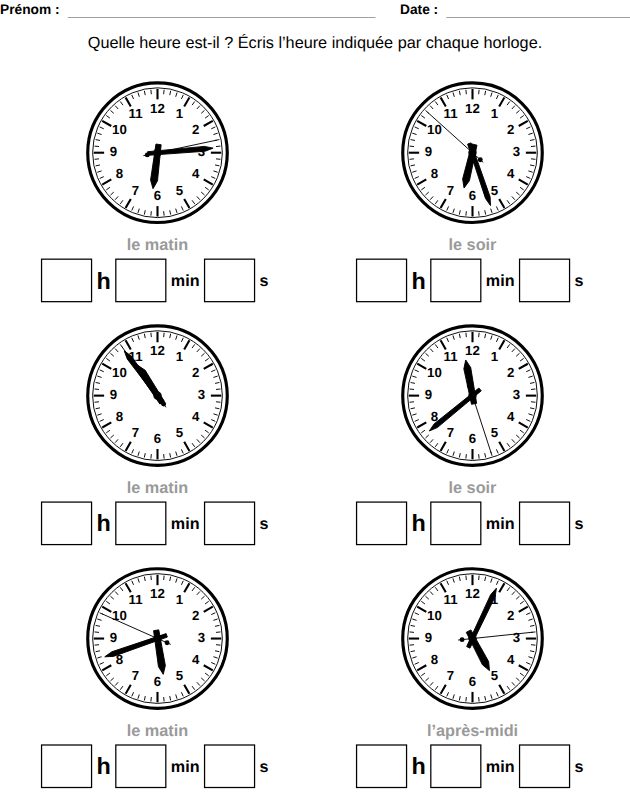
From ages 9-10, each clock is labelled morning or afternoon. The English book then shows times with AM and PM, and the other languages use the 24-hour clock.

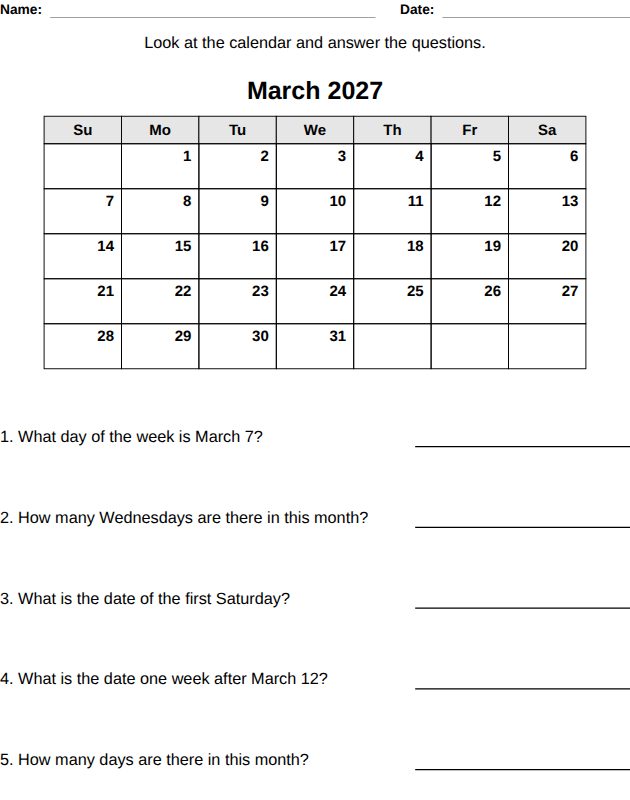
Calendar worksheet for kids, from the LogikLand telling time workbook

6. Calendar

Ages 5 to 10

At ages 5-7, children write the missing days of the week and months of the year in two lists. From ages 7-8, the page shows a real month of a year between 2026 and 2032 with 5 questions: the day of a date, how many Mondays (or another day) in the month, the date of the first Saturday, the date one week later, and the number of days. At ages 9-10 a sixth question asks on which day the next month starts.

One worksheet, many levels: reading the clock from 5 to 11

The same worksheet changes with the level. Here is the clock reading page at four ages: big clocks with o’clock times, then half past, then 5-minute steps, then hours, minutes and seconds.

Read the clock worksheet, Ages 5-6
Ages 5-6
Read the clock worksheet, Ages 6-7
Ages 6-7
Read the clock worksheet, Ages 8-9
Ages 8-9
Read the clock worksheet, Ages 10-11
Ages 10-11

Young children get 4 big clocks per page, older children 6. A book with several levels has one section per level, in order.

12-hour or 24-hour clock, depending on the language

The workbook is printed in English, French, Spanish, German or Italian. In English, all the clocks use the 12-hour time, with AM and PM on the matching page for the older levels. In the other languages, children from ages 9-10 also write afternoon and evening times with the 24-hour clock, for example 20 h 53 in French, and each clock says if it is morning, afternoon or evening.

Times in words follow the rules of each language too: “quarter to” in English, “moins le quart” in French, “menos cuarto” in Spanish, “Viertel vor” in German.

24-hour clock, French
Match the clocks, French

Answer key at the end of the book

Answer key: read the clock

Every clock and calendar worksheet has its answers in the answer key at the end of the book, with 2 or 4 answers per page. Each answer shows the page number of its worksheet, so a parent or a teacher can check a page quickly.

How to create this workbook

  1. Create a free account and open the Kids tab of your dashboard.
  2. Click the card of this workbook to see its worksheets and 3 example pages, then click Create this book.
  3. Choose the language, the title and the page size, then the levels by age or by school grade.
  4. Keep the worksheets you want and set the number of pages of each one per level.
  5. Choose the answer key and the margins, generate the book, then download a PDF or a PPTX file from the editor.

Every option is explained in the kids workbooks guide, and all the other workbooks are on the kids workbook generator page.

Frequently asked questions

Which ages does the telling time workbook cover?

Ages 5 to 11, from Ages 5-6 to Ages 10-11 (or Kindergarten to Grade 5 for a book in English). Reading the clock and drawing the hands start at ages 5-6, time in words and matching at 7-8, elapsed time at 8-9.

Does the workbook teach the 24-hour clock?

Yes, in the French, Spanish, German and Italian books, from ages 9-10. The English book keeps the 12-hour clock and uses AM and PM.

Can I make a book with only one kind of clock worksheet?

Yes. All the worksheets are selected at the start: untick the ones you do not want, and set the number of pages of each worksheet per level.

Are the times different on every page?

Yes. The times are drawn again for every page and every book, and the calendar pages show a different month and year.

Can I sell the telling time workbooks I create?

With a PRO or EXPERT plan, which include commercial rights, you can publish and sell your books, for example on Amazon KDP. Books made on the FREE plan are for personal use. The page limit per book is 50 on FREE, 100 on PRO and 200 on EXPERT.

Create your telling time workbook

Create a free account to try it, or choose a plan for longer books and commercial rights.

Related: All kids workbooks / Kids workbooks guide / Kids math workbook / Fractions, measures and money workbook / Plans and pricing

Last updated: October 28, 2026