Good handwriting is built in order: first the hand learns to follow a line, then to draw numbers and letters the right way, and later to join the letters. This guide follows those steps with real pages made with the free handwriting worksheet generator.
The four steps of handwriting practice
| Worksheet | Ages | What the child does |
|---|---|---|
| Pencil control | 3 to 6 | Follows dotted lines from the dot to the star |
| Trace the numbers | 3 to 7 | Traces 0 to 9, with circles to colour for the youngest |
| Capital letters | 4 to 7 | Traces the alphabet with the stroke order |
| Lowercase letters | 5 to 7 | Traces letters on 4 writing lines |
| Cursive letters | 6 to 10 | Traces joined letters, then writes them alone |
| Cursive words | 6 to 11 | Traces words, then sentences, and copies them |
Pencil control lines
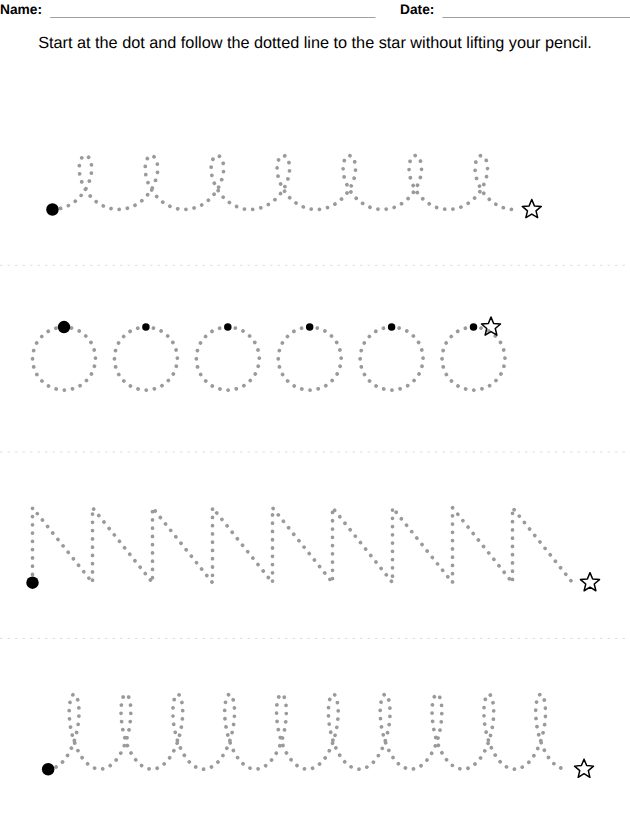
Before letters, the child learns to hold the pencil and to follow a path without lifting it. Each line starts at a dot and ends at a star: straight lines, waves, bridges, zigzags and loops. There are 4 big lines per page at ages 3-4, 5 at ages 4-5 and 6 at ages 5-6.
Numbers and letters with stroke order
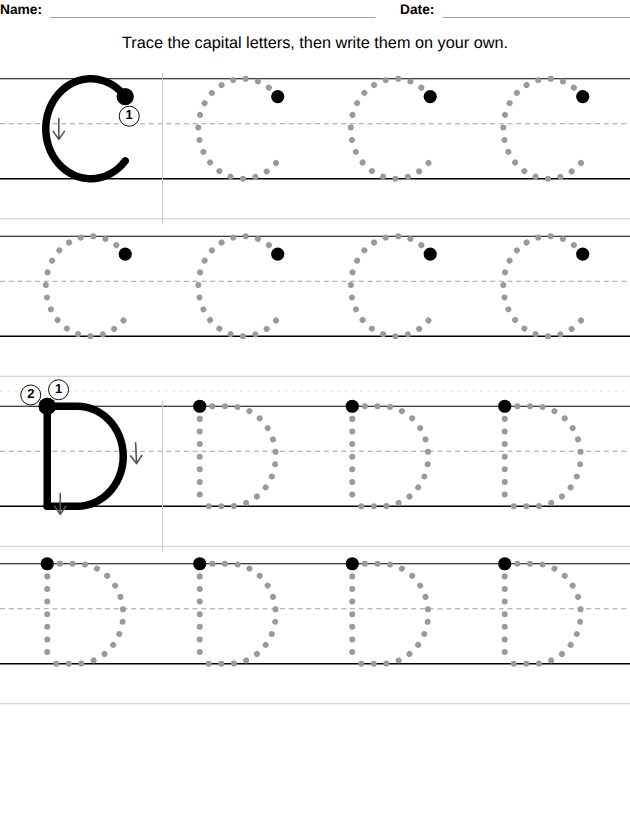
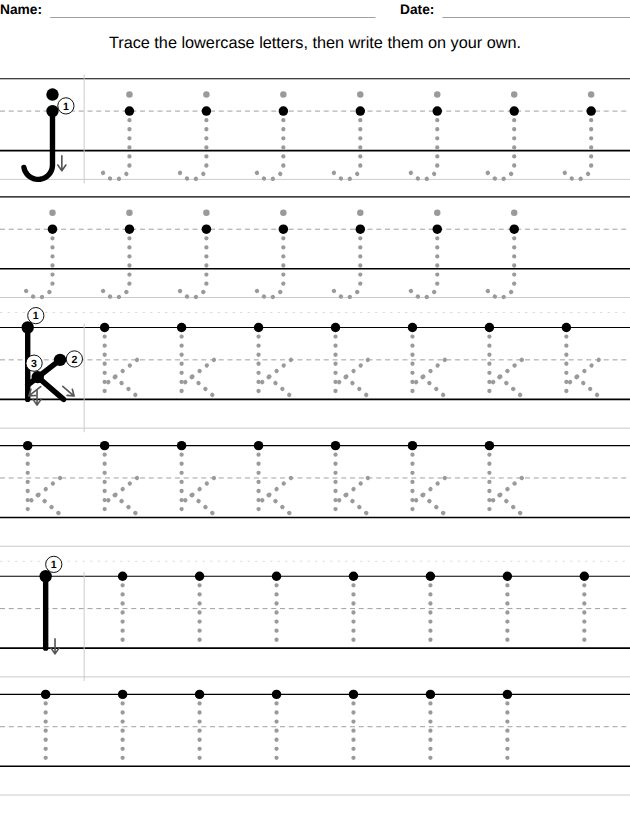
The first letter of each line is the model: it shows where to start, the number of each stroke and its direction. Then come dotted letters to trace. At ages 3-5 the letters are big and every box is dotted; from ages 5-6 they are smaller and the last boxes are empty, so the child writes alone. Lowercase letters sit on 4 writing lines, so the child sees which letters go up and which go down.
Tip
Ask the child to put a finger on the starting dot and say the stroke numbers before tracing the letter.
Cursive letters and words
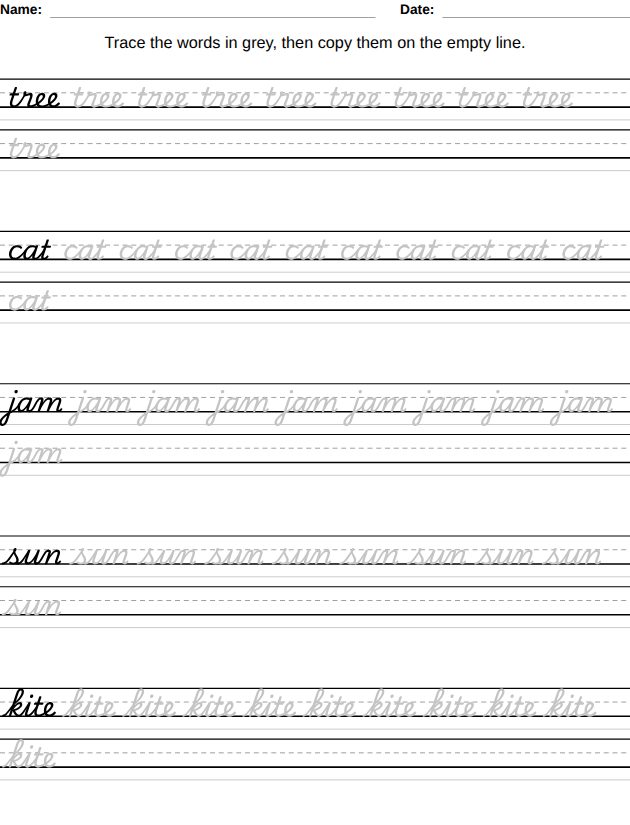
From ages 6-7 the child can start joined-up writing: one cursive letter per group, a black model, grey letters to trace, then room to write alone. The cursive words page follows: short words of up to 5 letters at ages 6-7, longer words after, and short sentences at ages 9-11. The cursive follows the school font of the language you choose, for example American cursive in English or French school cursive on Seyès lines.
Tips for a good practice session
Short pages, every day
A few lines done carefully help more than a long page done in a hurry.
Let the alphabet continue
Click New worksheet to move on to the next letters or numbers: the alphabet continues from page to page.
Start with the child’s name
Children like to write their own name. The free name tracing worksheet maker makes a page with the name, its starting dots and stroke numbers. For a whole book with alphabet games and spelling, see how to make a handwriting workbook.
Questions
What should a child trace before letters?
Lines. The pencil control pages have dotted lines to follow from the dot to the star: straight lines, waves, bridges, zigzags and loops. They exist for ages 3 to 6.
Do the worksheets show the stroke order?
Yes. On the number and letter pages, the model shows the starting dot, the number of each stroke and an arrow in its direction.
Which cursive is used?
The school cursive of the language you choose: American cursive in English, French school cursive on Seyès lines in French, and the school fonts of Spain, Germany and Italy.
Can my child trace their own name?
Yes, with the free name tracing worksheet maker. In the handwriting workbook, you can also type the first name in the book settings.
Related articles
- How to Teach a Child to Tell Time, Step by Step
The steps of learning the clock, from o’clock times at age 5 to every minute and elapsed time at age 11.
- Free Math Worksheets for Kids by Age (4 to 11)
A level-by-level guide to kids math worksheets, from counting dots at age 4 to long division at age 11.
Sources
This article is based on LogikLand's own puzzle generators.
Want to make a whole kids workbook?
LogikLand makes complete educational workbooks for ages 3 to 11: math, telling time, handwriting, word games, colouring, money, logic and picture activities, with the answer key at the end. Commercial rights come with the PRO and EXPERT plans.
Related: All blog articles | Try the tool | More Kids worksheets articles